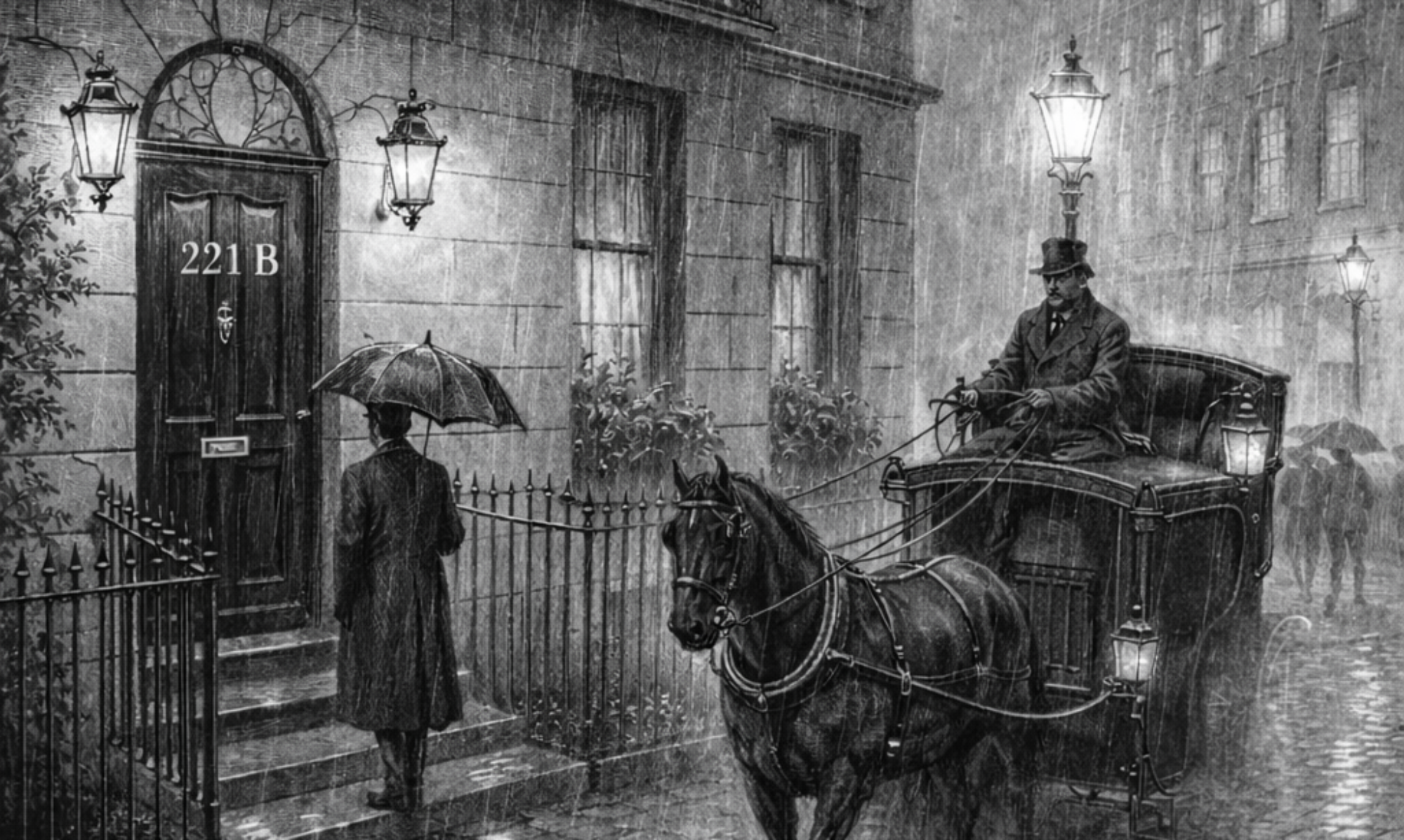
While there are hundreds of small inferences made throughout the 56 short stories and 4 novels of the “Canon,” Sherlock Holmes’s most famous deductions follow a specific pattern: he observes “trifles” (minor details) and uses them to reconstruct a person’s history or the mechanics of a crime. Below is a categorized list of the most iconic and structurally significant deductions in the literature.
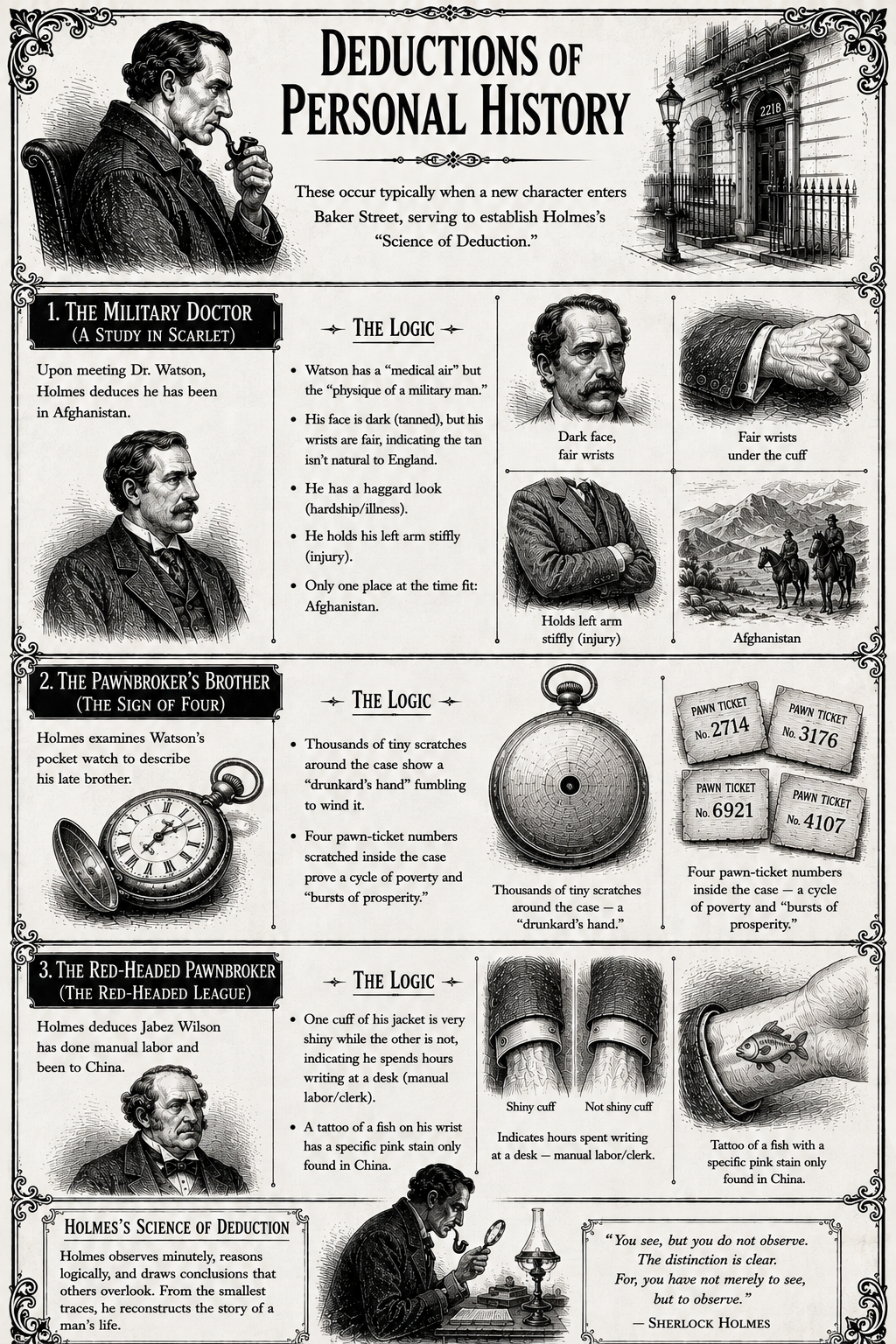
1 – Deductions of Personal History
These occur typically when a new character enters Baker Street, serving to establish Holmes’s “Science of Deduction.”
The Military Doctor (A Study in Scarlet): Upon meeting Dr. Watson, Holmes deduces he has been in Afghanistan.
The Logic: Watson has a “medical air” but the “physique of a military man.” His face is dark (tanned), but his wrists are fair, indicating the tan isn’t natural to England. He has a haggard look (hardship/illness) and holds his left arm stiffly (injury). Only one place at the time fit: Afghanistan.
The Pawnbroker’s Brother (The Sign of Four): Holmes examines Watson’s pocket watch to describe his late brother.
The Logic: Thousands of tiny scratches around the keyhole show a “drunkard’s hand” fumbling to wind it. Four pawn-ticket numbers scratched inside the case prove a cycle of poverty and “bursts of prosperity.”
The Red-Headed Pawnbroker (The Red-Headed League): Holmes deduces Jabez Wilson has done manual labor and been to China.
The Logic: One cuff of his jacket is very shiny while the other is not, indicating he spends hours writing at a desk (manual labor/clerk). A tattoo of a fish on his wrist has a specific pink stain only found in China.

2 – Deductions from Objects
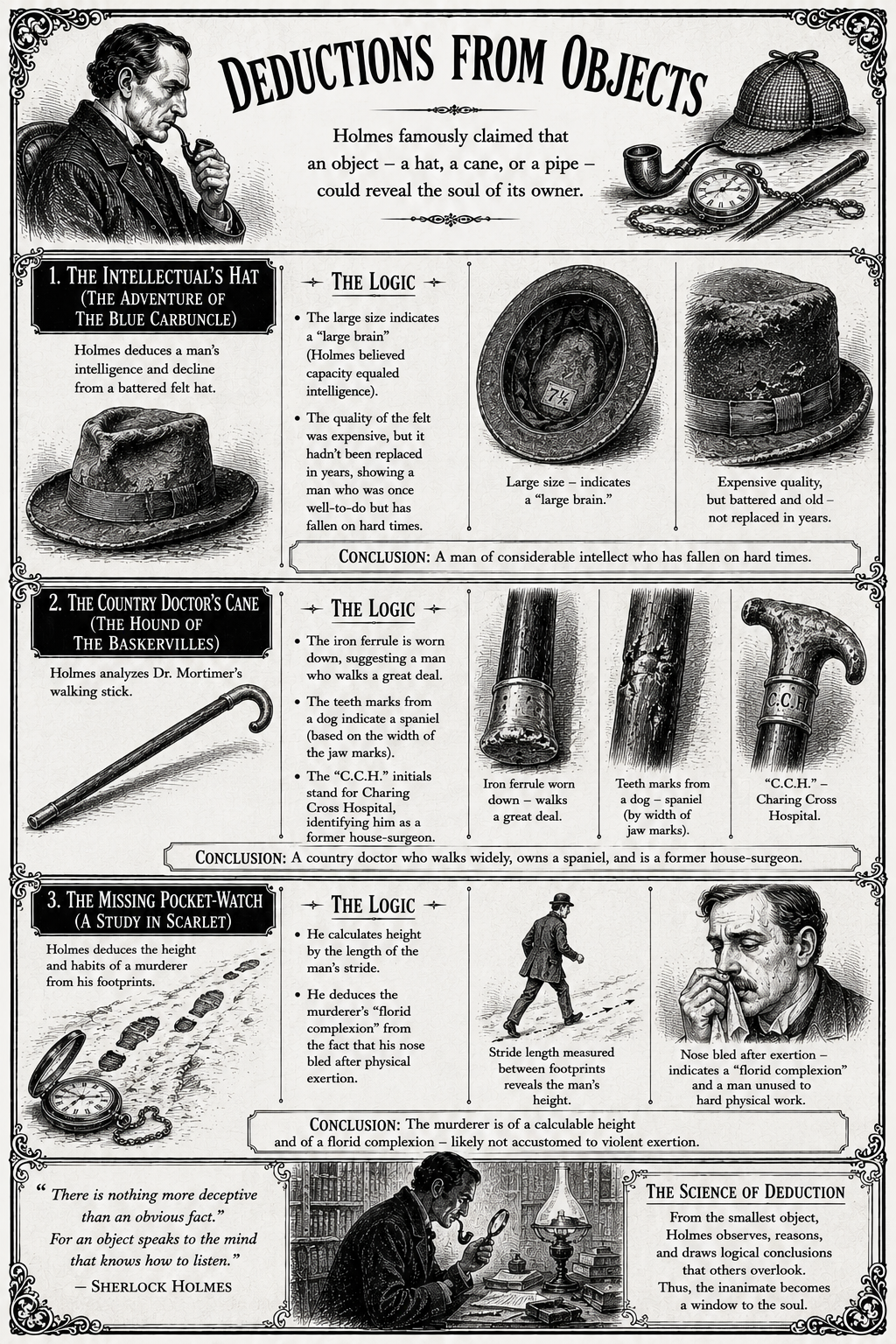
Holmes famously claimed that an object – a hat, a cane, or a pipe – could reveal the soul of its owner.
The Intellectual’s Hat (The Adventure of the Blue Carbuncle): Holmes deduces a man’s intelligence and decline from a battered felt hat.
The Logic: The large size indicates a “large brain” (Holmes believed capacity equaled intelligence).
The quality of the felt was expensive, but it hadn’t been replaced in years, showing a man who was once well-to-do but has fallen on hard times.
The Country Doctor’s Cane (The Hound of the Baskervilles): Holmes analyzes Dr. Mortimer’s walking stick.
The Logic: The iron ferrule is worn down, suggesting a man who walks a great deal. The teeth marks from a dog indicate a spaniel (based on the width of the jaw marks), and the “C.C.H.” initials stand for Charing Cross Hospital, identifying him as a former house-surgeon.
The Missing Pocket-Watch (A Study in Scarlet): Holmes deduces the height and habits of a murderer from his footprints.
The Logic: He calculates height by the length of the man’s stride. He deduces the murderer’s “florid complexion” from the fact that his nose bled after physical exertion.

3 – Forensic & Crime Scene Deductions
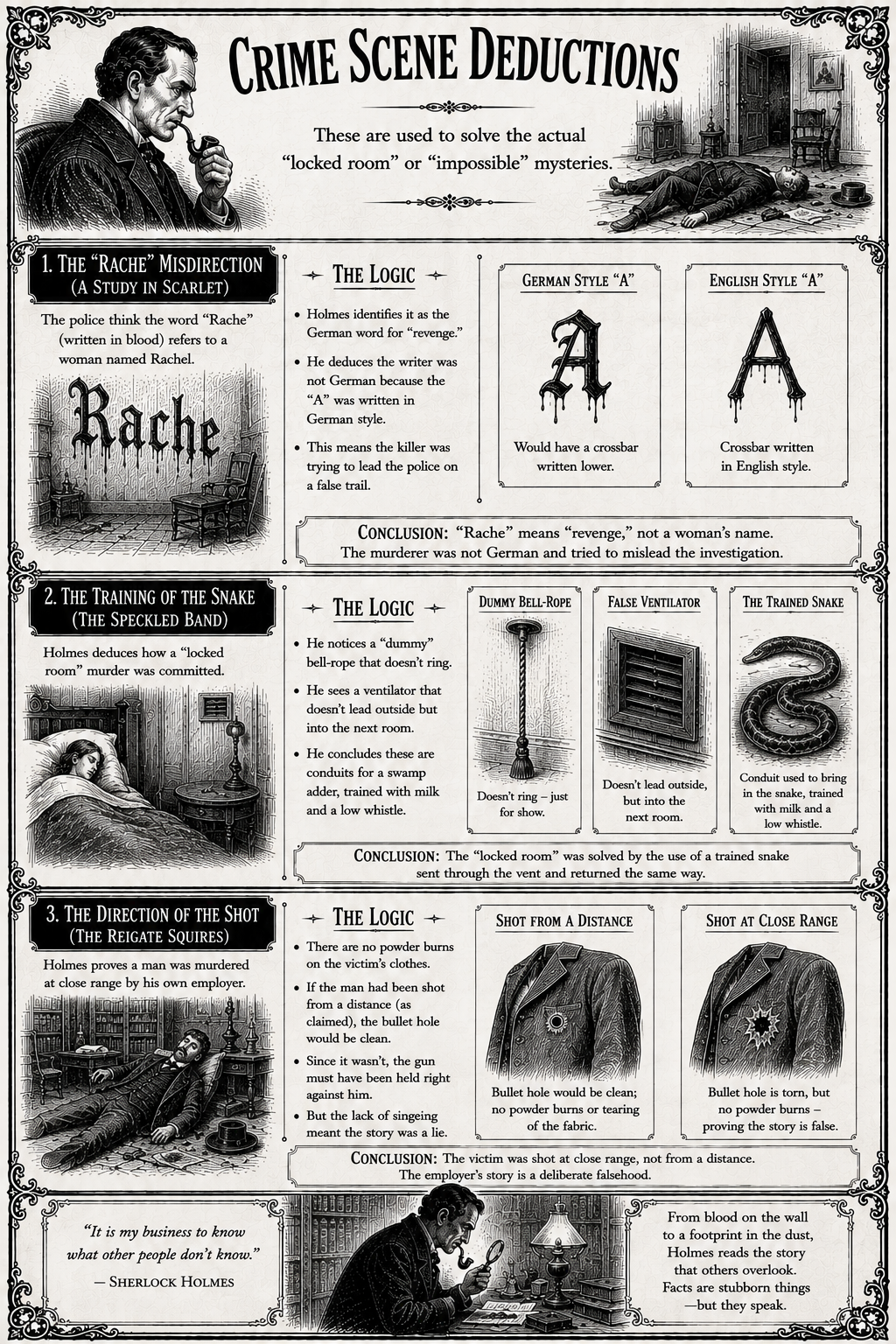
These are used to solve the actual “locked room” or “impossible” mysteries.
The “Rache” Misdirection (A Study in Scarlet): The police think the word “Rache” (written in blood) refers to a woman named Rachel.
The Logic: Holmes identifies it as the German word for “revenge.” He deduces the writer was not German because the “A” was written in German style, meaning the killer was trying to lead the police on a false trail.
The Training of the Snake (The Speckled Band): Holmes deduces how a “locked room” murder was committed.
The Logic: He notices a “dummy” bell-rope that doesn’t ring and a ventilator that doesn’t lead outside but into the next room. He concludes these are conduits for a swamp adder, trained with milk and a low whistle.
The Direction of the Shot (The Reigate Squires): Holmes proves a man was murdered at close range by his own employer.
The Logic: There are no powder burns on the victim’s clothes. If the man had been shot from a distance (as claimed), the bullet hole would be clean; since it wasn’t, the gun must have been held right against him, but the lack of singeing meant the story was a lie.
Sherlock Holmes and Abductive Reasoning
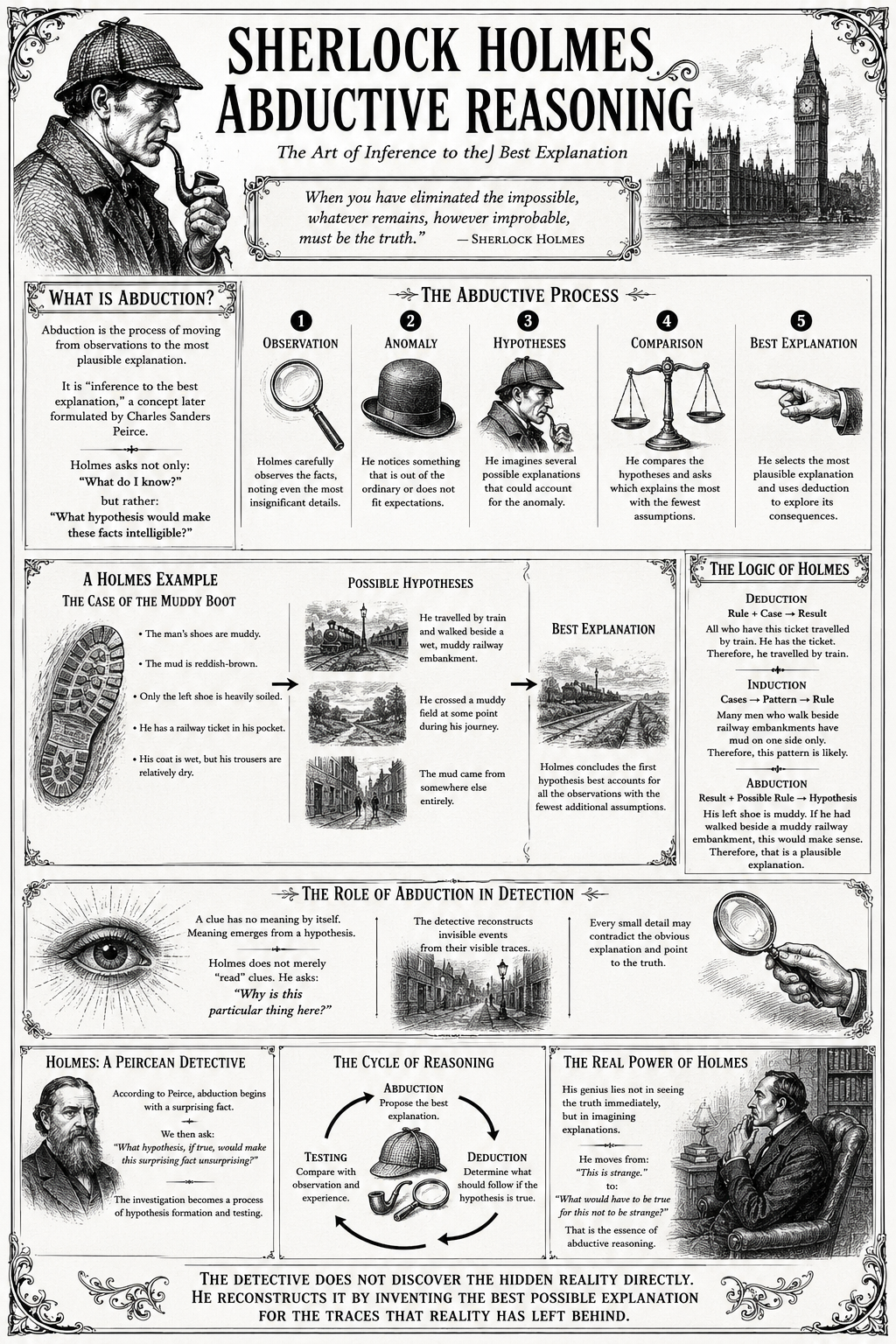
Holmes does not simply ask, “What facts do I know?” He asks a more powerful question:
“What hypothesis would make these facts intelligible?”
This is the essence of abductive reasoning, a concept later formulated by the philosopher Charles Sanders Peirce as inference to the best explanation.
Suppose Holmes observes:
– a man’s shoes are muddy;
– the mud is reddish-brown;
– only the left shoe is heavily soiled;
– the man has a railway ticket in his pocket;
– his coat is wet, but his trousers are relatively dry.
Holmes does not deduce the man’s entire journey with mathematical certainty. Instead, he constructs possible explanations and asks which one best accounts for the whole constellation of clues.
Perhaps the man recently walked beside a railway embankment after rain. Perhaps he stepped out of a train and crossed muddy ground. Perhaps the mud came from somewhere else entirely.
Holmes compares these hypotheses and chooses the one that explains the greatest number of observations with the fewest additional assumptions.
The Logic of Holmes
Holmes’s reasoning can therefore be represented as:
Observation → Anomaly → Hypotheses → Comparison → Best Explanation → Verification
The important moment is the movement from effect to possible cause.
Deduction normally works like this:
Rule + Case → Result
For example:
All people who possess a certain ticket have travelled by train.
Watson possesses the ticket.
Therefore, Watson travelled by train.
Induction works differently:
Cases → Pattern → General Rule
But abduction works like this:
Result + possible rule → hypothesis
The man’s clothes suggest that he has recently travelled through wet countryside.
If he had travelled through wet countryside, these traces would make sense.
Therefore, travelling through wet countryside is a plausible explanation.
The conclusion is not certain. It is hypothetical.
That distinction is crucial to understanding Holmes.
Holmes Does Not Merely “Read” Clues
A common interpretation of Holmes presents him as someone who looks at a clue and immediately knows its meaning. But his method is more sophisticated.
A clue does not possess a fixed meaning by itself.
Meaning emerges from a hypothesis.
A speck of mud might mean almost nothing. But once Holmes considers the hypothesis that a person has recently crossed a particular kind of terrain, the mud becomes significant.
Thus:
Clue → Hypothesis → Interpretation
rather than simply:
Clue → Conclusion
This is why Holmes continually constructs and eliminates explanations.
Abduction and the “Science of Trifles”
Holmes’s famous attention to apparently insignificant details can be understood as an abductive strategy.
A small anomaly is valuable because it may contradict the obvious explanation.
For Holmes, the question is not merely:
What do I see?
but:
Why is this particular thing here?
The unusual cigarette ash, a missing button, a footprint, a particular type of handwriting, or an apparently insignificant alteration in a room can become important because Holmes asks what causal story would explain its presence.
The detective therefore reconstructs an invisible event from its visible traces.
In this sense, the crime scene becomes a kind of semiotic system: objects are signs of events that are no longer directly observable.
The Three Forms of Reasoning
Holmes’s method can be represented through the classical distinction:
| Reasoning | Direction | Function |
|---|---|---|
| Deduction | Rule → Case → Result | Establishes what must follow |
| Induction | Cases → Pattern → Rule | Establishes what tends to occur |
| Abduction | Result → Possible Cause | Proposes what might explain the evidence |
Holmes needs all three.
Abduction generates the hypothesis.
Deduction explores what should be true if the hypothesis is correct.
Observation and induction then help determine whether the hypothesis fits experience.
So the detective’s reasoning is not simply:
“I have deduced the answer.”
It is closer to:
“I have found an explanation that accounts for the evidence. Now I must test it.”
Holmes as a Peircean Detective
This makes Holmes particularly interesting from the perspective of Peirce’s philosophy of signs.
Peirce’s abductive logic begins with a surprising observation:
Something unexpected has occurred.
The mind then asks:
What hypothesis, if true, would make this surprising fact unsurprising?
The detective performs precisely this operation.
A mysterious footprint is surprising.
A hypothesis about who made it, when, and under what circumstances makes the footprint intelligible.
The investigation then becomes a process of hypothesis formation and testing.
Holmes is therefore not simply a machine for extracting conclusions from clues. He is a generator of hypotheses.
The Real Power of Holmes
The deepest feature of Holmes’s reasoning is consequently not that he possesses extraordinary powers of deduction.
It is that he is exceptionally good at imagining explanations.
His genius lies in the ability to move from:
“This is strange.”
to:
“What would have to be true for this not to be strange?”
That is the fundamental movement of abduction.
And it explains why Sherlock Holmes remains such an influential model of detective reasoning: the detective does not discover the hidden reality directly. He reconstructs it by inventing the best possible explanation for the traces that reality has left behind.