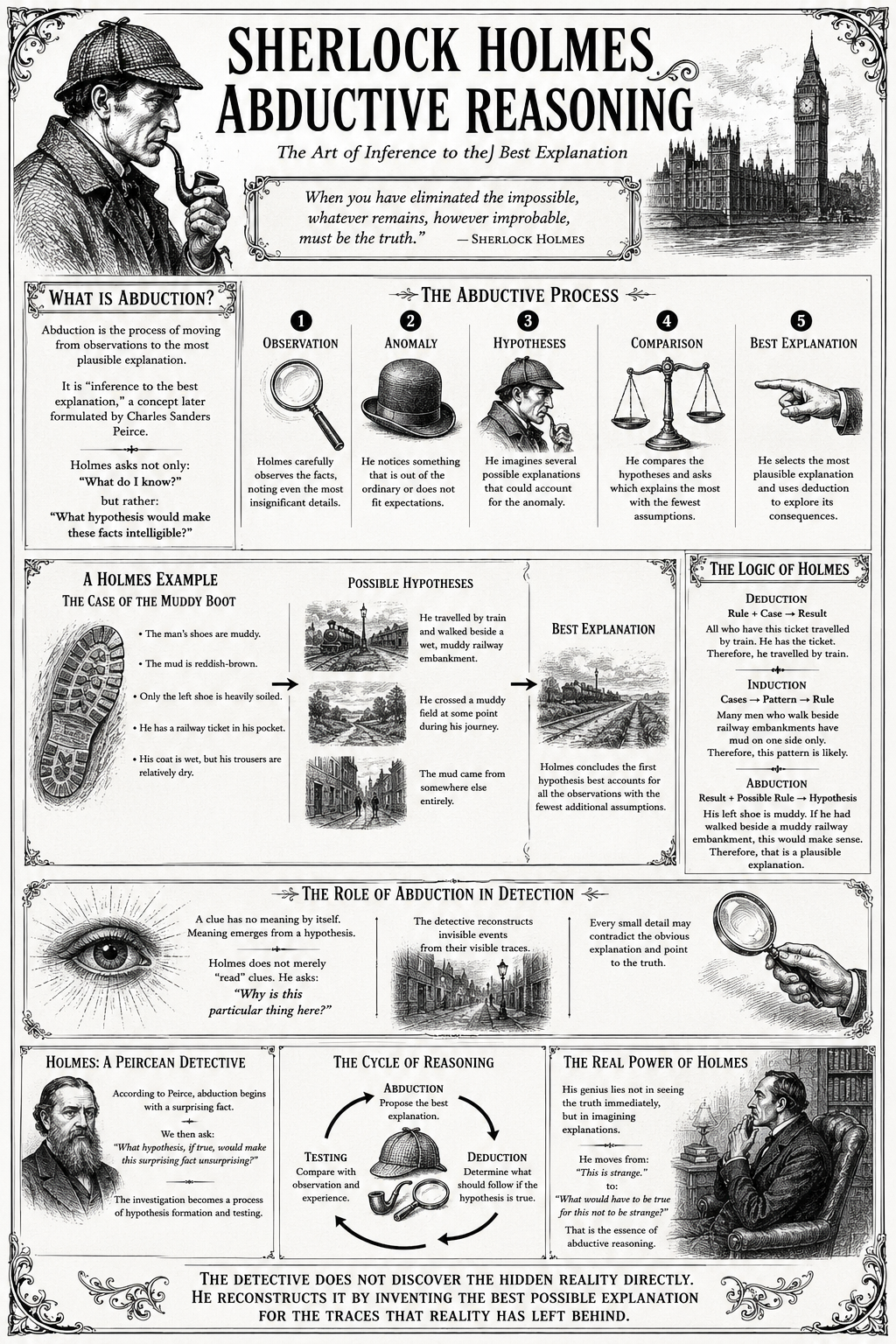
The Sherlockian Great Game is a playful intellectual tradition in which Sherlock Holmes and the world of the Holmes stories are treated as if they were historically real, while Arthur Conan Doyle is treated not as the author but as a kind of editor, translator, or literary intermediary. It is called the “Great Game” because participants play a game of interpretation: they take the fictional evidence in the stories seriously and try to reconstruct the “real” biography, chronology, psychology, and adventures of Holmes and Watson.
1. The basic premise
The central rule is essentially:
Holmes is real; Watson wrote the stories; Doyle merely published or edited them.
So instead of asking:
“Why did Conan Doyle write this story this way?”
the Sherlockian asks:
“Why did Dr. Watson report the case this way?”
This produces an unusual form of literary criticism that deliberately blurs the boundary between fiction and historical investigation.
For example, Watson sometimes gives contradictory dates, omits information, or describes events inconsistently. The Great Game treats these not necessarily as mistakes by Doyle, but as problems in Watson’s narration that need to be explained.
2. Sherlockians become detectives
The Sherlockian essentially becomes another version of Holmes. They collect clues from the canon—the Holmes stories—and attempt to reconstruct information that Doyle never explicitly provides. Questions might include:
What was Holmes’s exact date of birth?
– Where did Holmes attend university?
– What was Watson’s medical career?
– When exactly did Watson marry Mary Morstan?
– How many times was Watson married?
– What was Holmes’s relationship with his brother Mycroft?
– What happened during the mysterious years when Holmes was believed dead?
– Why does Watson sometimes contradict himself?
– What cases occurred between the stories we know?
The investigator tries to solve these problems through deduction, inference, chronology, textual comparison, and sometimes elaborate speculation.
3. The Sherlock Holmes Canon
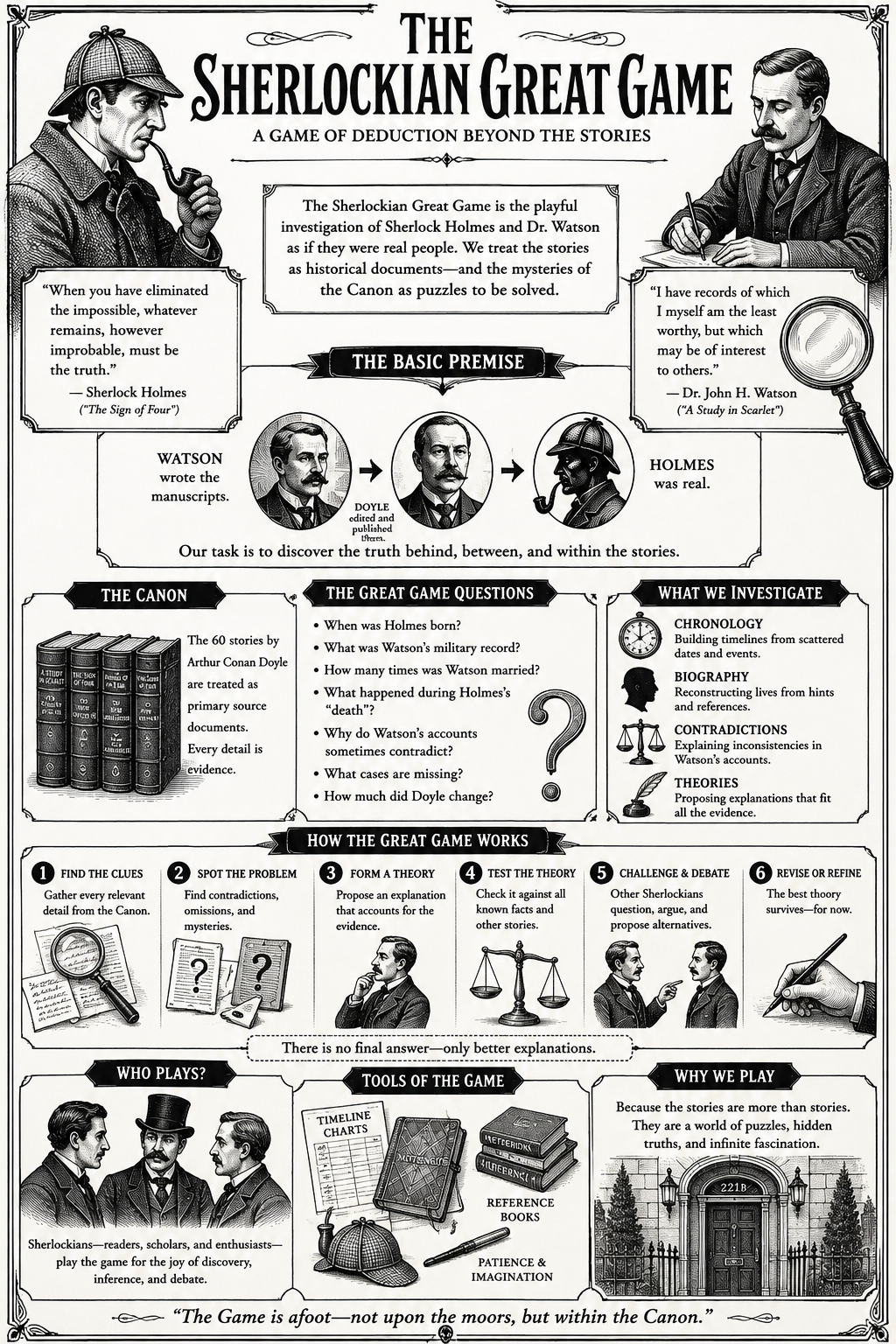
The raw material of the Great Game is usually called the Sherlock Holmes Canon: the 60 Holmes stories published by Conan Doyle, consisting of four novels and 56 short stories. Sherlockians treat these stories almost like historians would treat a collection of primary documents.
A statement in one story can therefore be compared with another statement many years later. For example, if Watson says something about his military service in one story and something apparently contradictory in another, the Sherlockian asks:
Can the contradiction be explained?
Perhaps:
– Watson made a mistake.
– Watson deliberately concealed something.
– Doyle altered Watson’s manuscripts.
– There are different versions of Watson’s memoirs.
– Two apparently contradictory events actually occurred at different times.
The more inventive explanations can become extremely elaborate.
One of the characteristic jokes of the Great Game is that Conan Doyle is not really the author. Instead, Sherlockians might imagine that:
Dr. John Watson → wrote the manuscripts → Conan Doyle edited them → the public received the published stories.
This allows Sherlockians to explain stylistic differences, omissions, inconsistencies, and historical problems.
Doyle’s own statements about Holmes can even be treated with suspicion.
If Doyle says something contradicting the stories, the Sherlockian might effectively respond:
“Doyle would say that. He wasn’t Watson.”
This is part of the humor.
4. Doyle becomes Watson’s “literary agent”
One of the characteristic jokes of the Great Game is that Conan Doyle is not really the author.
Instead, Sherlockians might imagine that:
Dr. John Watson → wrote the manuscripts → Conan Doyle edited them → the public received the published stories.
This allows Sherlockians to explain stylistic differences, omissions, inconsistencies, and historical problems.
Doyle’s own statements about Holmes can even be treated with suspicion.
If Doyle says something contradicting the stories, the Sherlockian might effectively respond:
“Doyle would say that. He wasn’t Watson.”
This is part of the humor.
5. The Great Game and “higher criticism”
The tradition has an important connection with biblical and historical textual criticism.
Scholars studying ancient texts often ask:
- Who actually wrote this document?
- When was it written?
- Were different sources combined?
- Why does one passage contradict another?
- What editorial process produced the surviving text?
Sherlockians apply essentially the same methods to the Holmes Canon—but playfully.
Thus, a Holmes story becomes almost like an ancient manuscript. Watson becomes the primary source. Doyle becomes an editor. Sherlock Holmes becomes the historical person being reconstructed, and the Sherlockian becomes the scholar-detective.
6. An example: Watson’s wives
One famous type of Great Game problem concerns Watson’s marital history.
The stories contain information about Watson’s marriage to Mary Morstan, but Watson’s later domestic circumstances are not always perfectly consistent.
A conventional literary critic might simply say:
“Conan Doyle was inconsistent.”
A Sherlockian instead asks:
“What actually happened to Watson?”
The task becomes reconstructing Watson’s biography from scattered textual evidence.
This is where the Great Game becomes particularly fascinating: the inconsistency itself becomes a clue.
7. Why is it called a “game”?
The term Great Game is generally associated with the early Sherlockian scholar and writer Ronald Knox, whose 1920 essay Studies in the Literature of Sherlock Holmes famously approached Holmes scholarship in this mock-serious fashion. The word “game” is important because participants know that they are pretending.
There is a double consciousness:
On one level:
Sherlock Holmes is obviously fictional.
On another level:
Let’s assume he was real and see how far the evidence takes us.
That tension produces the humor and intellectual pleasure of the Great Game.
8. The Great Game is more than a joke
What makes the tradition interesting is that it anticipates several important ideas in modern literary theory.
It raises questions about:
Author vs. narrator
Who is actually responsible for what we read?
Fiction vs. reality
What happens when we treat fictional evidence as historical evidence?
Textual inconsistencies
Can contradictions be interpreted rather than simply dismissed as errors?
The unreliable narrator
Can Watson’s account be trusted?
Intertextuality
How do different Holmes stories modify our understanding of one another?
Metafiction
What happens when a fictional character appears to have an independent existence beyond his author?
In this sense, the Great Game is a form of playful pseudo-scholarship, but it also contains a surprisingly sophisticated theory of fiction.
9. The connection with Borges and the Purloined
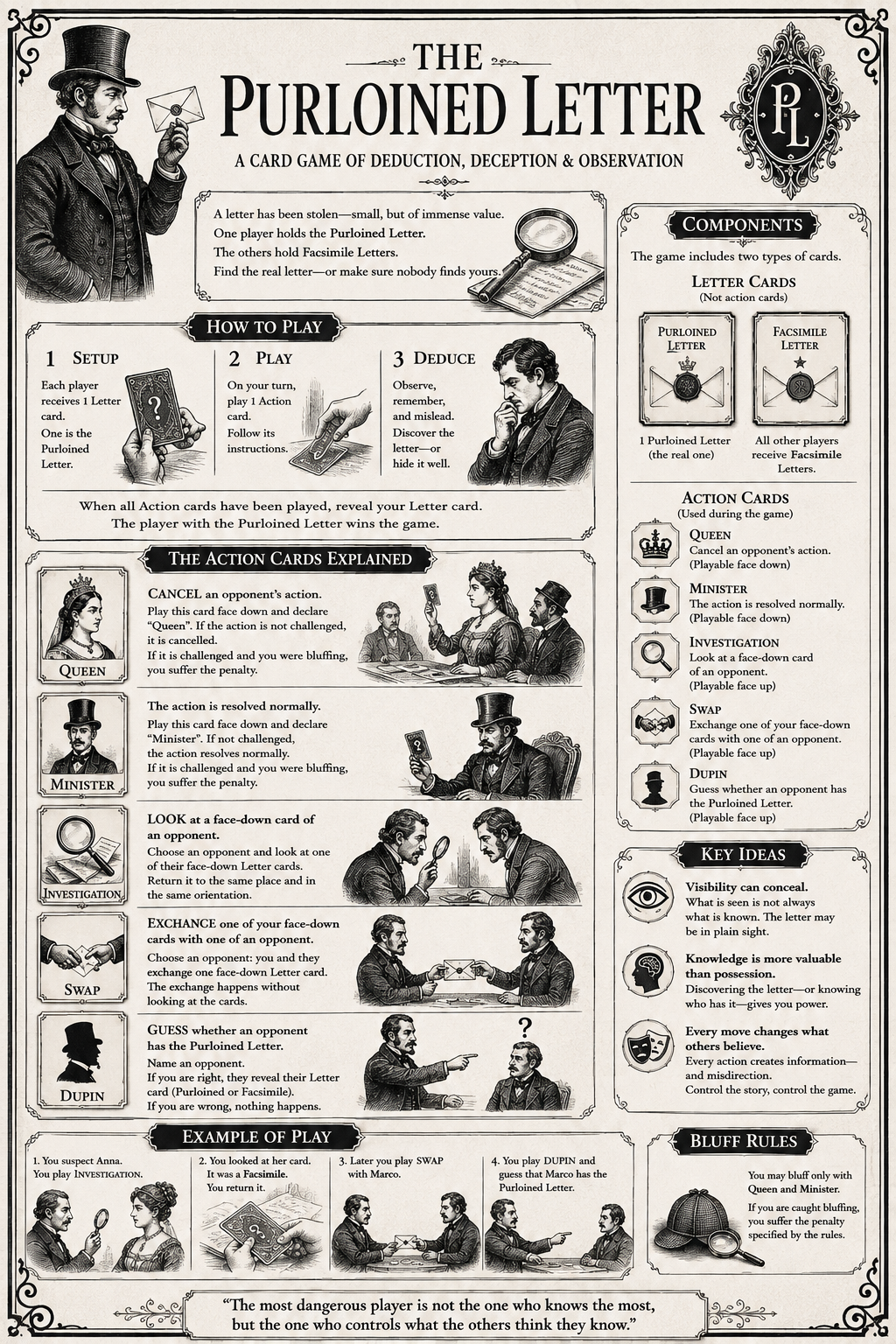
There is also an interesting connection with the kind of detective-fiction theory surrounding Poe and Borges. In Auguste Dupin’s world, the detective reconstructs a hidden reality from textual and material clues. Holmes does something similar. But the Great Game adds another layer: the reader becomes the detective.
The Holmes story itself becomes the crime scene. The inconsistencies become clues. Watson becomes a potentially unreliable witness. Doyle becomes a suspicious intermediary, and the Sherlockian reconstructs an invisible reality that supposedly exists behind the text.
This makes the Great Game almost a second-order detective story:
Holmes solves crimes inside Watson’s stories; Sherlockians solve the mysteries inside the Holmes stories. That is probably the most interesting way to understand the Great Game. It transforms reading itself into detection.