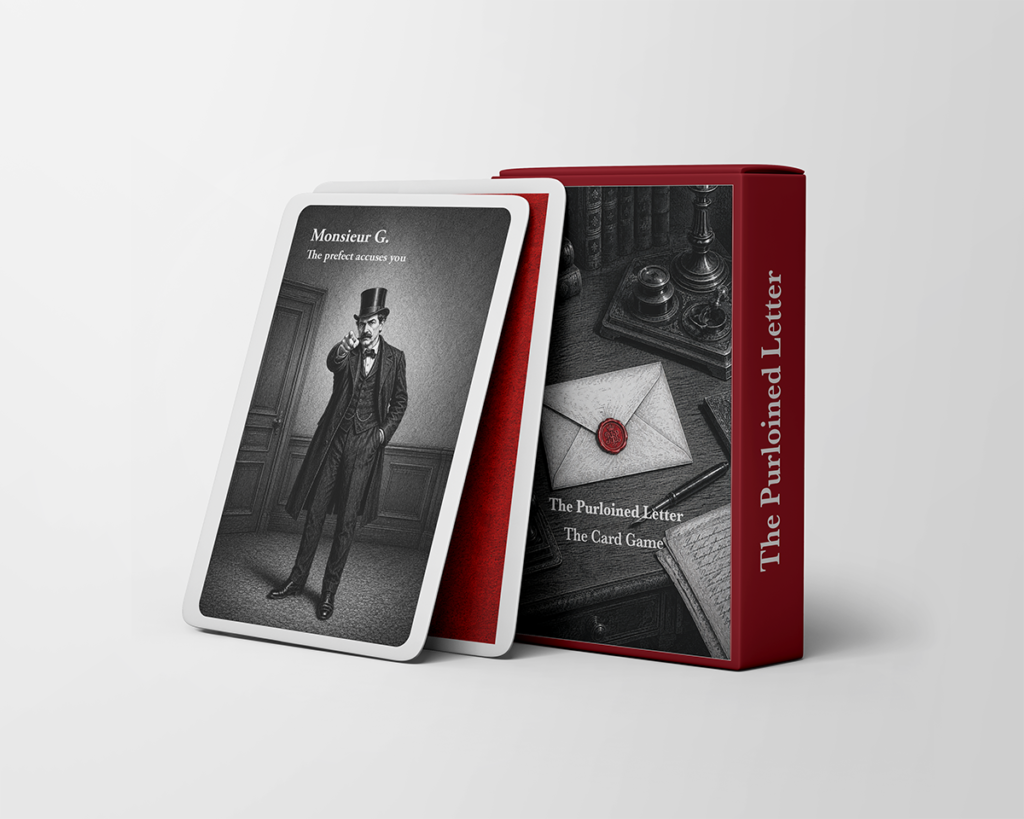
A mysterious letter has been stolen from the royal apartments. It is small, apparently ordinary, and yet it is worth more than anything else on the table. Everyone knows that the letter exists. No one, however, can be certain who possesses it.
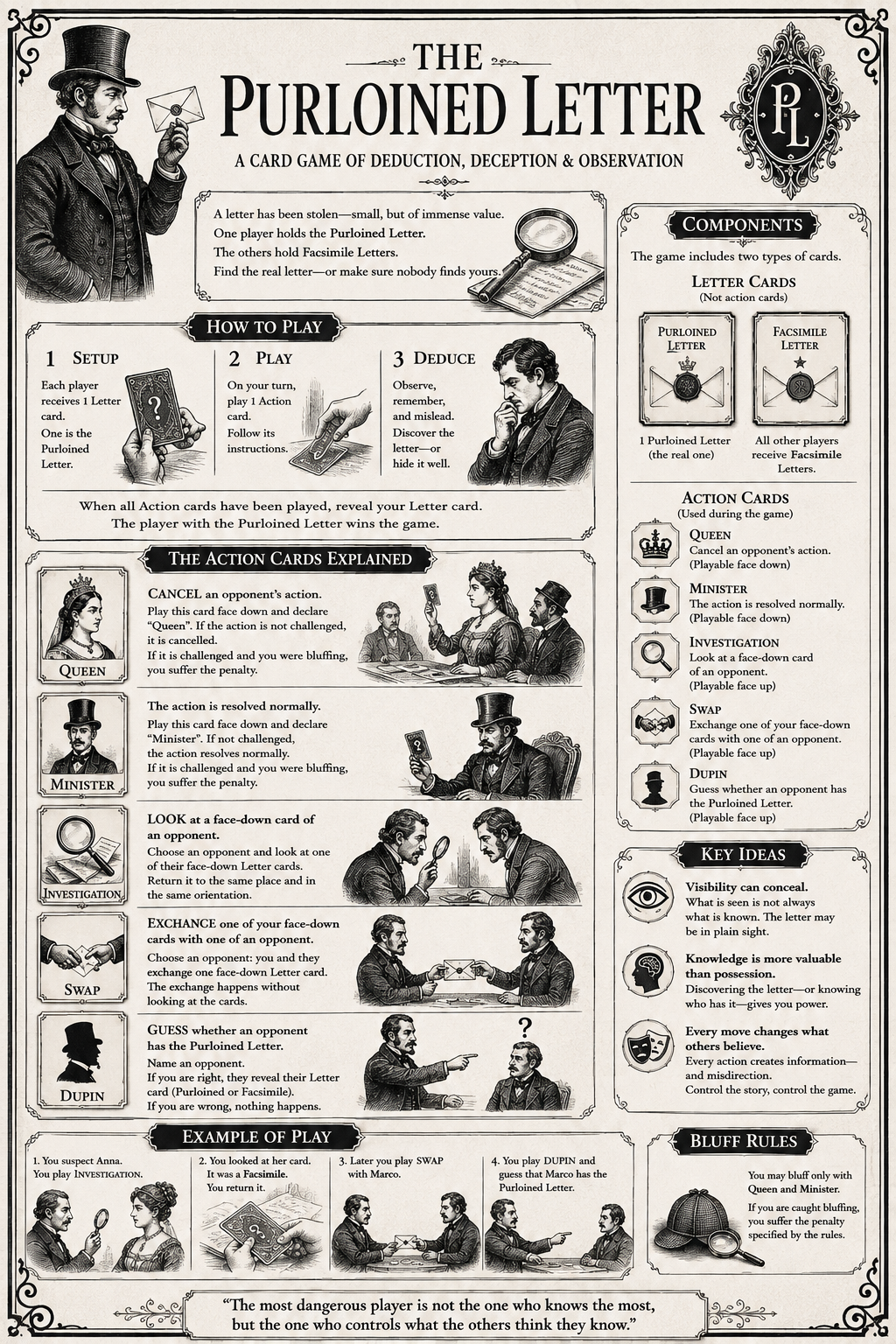
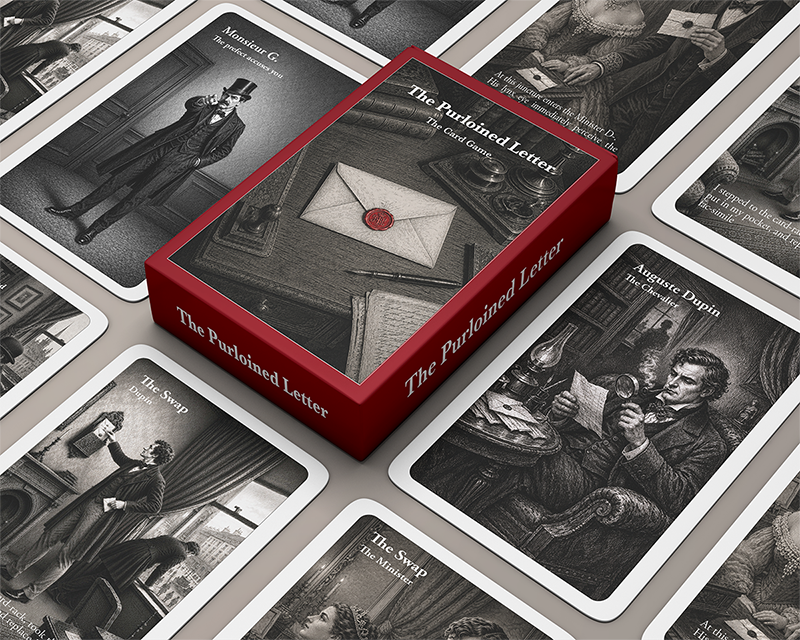
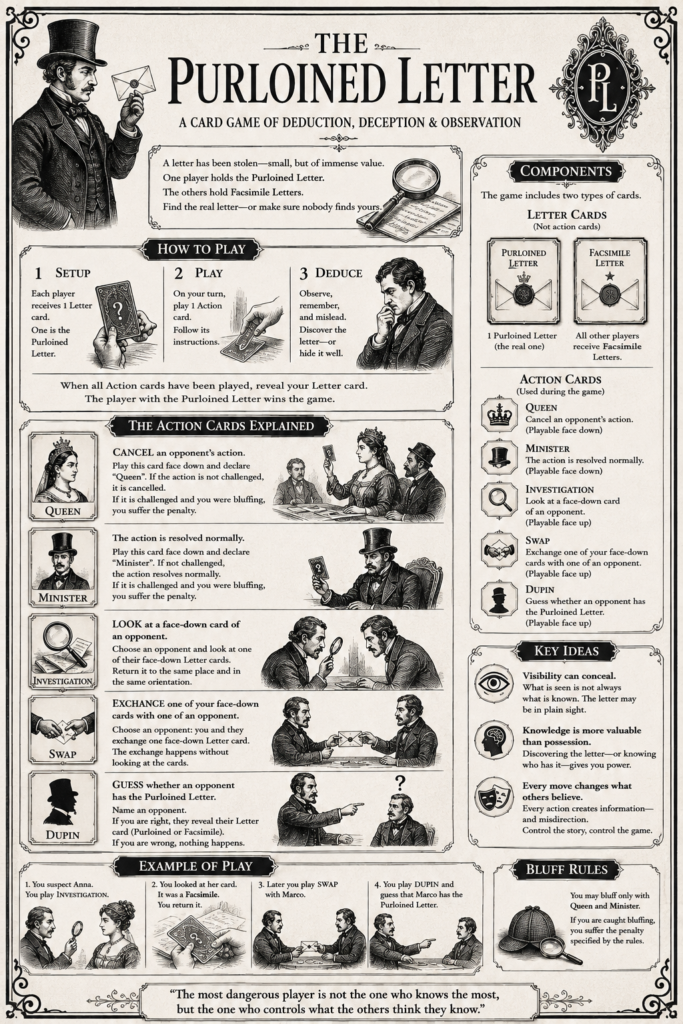
The Purloined Letter is a fast card game of deduction, observation, bluff, and deception, inspired by Edgar Allan Poe’s famous tale The Purloined Letter. Each player secretly holds a Letter card: one is the genuine stolen letter, while the others are facsimiles.
Your task is simple: find the stolen letter—or make sure nobody finds yours.
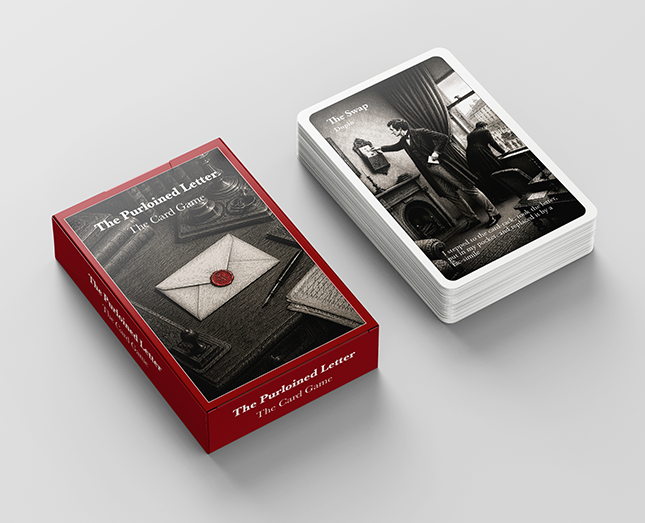
During the game, players use the abilities of the Queen, Minister, Investigation, Swap, and Dupin cards to gather information, interfere with opponents, exchange hidden cards, and manipulate what everyone else believes. Some actions reveal information; others deliberately conceal it. The Queen and Minister can even be played face down, allowing players to bluff about what they hold.
But information is never complete. A player may know the identity of another player’s letter, but not where that letter will be on the next turn. A seemingly harmless Facsimile may become the target of everyone’s suspicion, while the real letter quietly changes hands.
The most dangerous player is not necessarily the one who knows the most. It is the one who can control what the others think they know.
As in Poe’s story, the crucial question is not simply:
“Where is the letter?”
but:
“Who knows where it is—and what do they want me to believe?”
When all the cards have been played, the players reveal their Letters. The player holding the Purloined Letter wins the game.
In this game, observation is power, information is a weapon, and sometimes the best hiding place is the one everyone has already seen.
A deduction, deception, and psychological bluff card game inspired by Edgar Allan Poe’s The Purloined Letter.
In Poe’s story, the letter is never truly hidden—it is disguised by its obviousness. The game recreates this paradox. Players know that the Letter is somewhere on the table, yet no one knows who truly controls it. Victory belongs not to the player who hides best, but to the one who best manipulates everyone else’s perception.
The Purloined Letter is not simply a game about finding a hidden card. Its mechanics are built around three connected ideas: visibility, knowledge, and belief. These three ideas determine how players interpret the information they receive and how they decide to act.
1. Visibility can conceal
The central paradox of the game is that what is visible is not necessarily what is known.
Every player openly participates in the game. Cards are played, exchanged, observed, and sometimes revealed. Yet the most important piece of information—the identity and location of the Purloined Letter—remains uncertain.
The Facsimile Letters are essential to this mechanism. They look and behave like the real Letter, creating multiple possible targets. A player may discover that another player possesses a Letter, but this does not necessarily mean they have discovered the stolen Letter.
This reflects the central idea of Poe’s story: something can be hidden precisely because it is in plain sight. The problem is not always seeing the object; it is recognizing what one is looking at.
2. Knowledge is more valuable than possession
Possessing a card is not always as important as knowing what another player possesses.
An Investigation card, for example, does not give you the Letter. It gives you information.
Dupin can reveal information that may allow you to make a better decision later. Even a failed attempt to discover the Letter can be useful because it changes what you know about the other players.
Information can therefore become a form of power.
A player who knows that Anna has a Facsimile can safely ignore her. A player who knows that Marco has the genuine Letter can begin manipulating the other players into attacking Marco. Conversely, a player who knows nothing may still win by creating the illusion that they know everything.
The game therefore creates an important distinction:
Having the Letter gives you the objective advantage. Knowing where the Letter is gives you the strategic advantage.
3. Every move changes what others believe
Every action in the game produces two effects.
The first is the actual effect of the card: a card is observed, exchanged, protected, or transferred.
The second is psychological: the other players interpret what you have done.
Suppose a player uses Investigation on another player. They may have discovered the genuine Letter—or a Facsimile. The other players don’t know which one.
Perhaps you use Swap. Did you exchange a useless Facsimile, or did you deliberately risk giving away the real Letter?
Perhaps you declare “Regina” while playing a card face down. Even if nobody challenges you, the other players must now decide whether they believe you.
This means that every move generates a new set of beliefs around the table.
A good player therefore asks not only:
“What does this card do?”
but also:
“What will the other players think this card means?”
That is where bluffing becomes important. A player can deliberately create a false interpretation, encouraging the others to pursue the wrong Letter, suspect the wrong player, or believe that a particular card is somewhere it is not.
The Game as a System of Beliefs
These three ideas are connected:
Visibility → Knowledge → Belief
You see something.
You interpret what you see.
The other players interpret your interpretation.
And their actions change the situation again.
This creates a constantly shifting game in which the physical location of the Letter is only part of the puzzle. The other part is the network of beliefs that the players construct around it.
The ultimate skill is therefore not simply to hide the Letter.
It is to control the story that everyone else tells themselves about where the Letter is.
That is the heart of The Purloined Letter.