The phrase “Elementary, my dear Watson” is one of the most famous expressions associated with Sherlock Holmes. It is so strongly connected with the detective that it seems impossible to imagine Holmes without it. Yet there is a curious problem: Holmes never actually says the phrase in any of the original 56 short stories or four novels featuring his character.
The closest example appears in “The Adventure of the Crooked Man.” In that story, Holmes uses the word elementary and the expression my dear Watson within the same exchange—but he does not combine them into the famous phrase.
Holmes first explains to Watson how he has deduced the way he arrived at Baker Street:
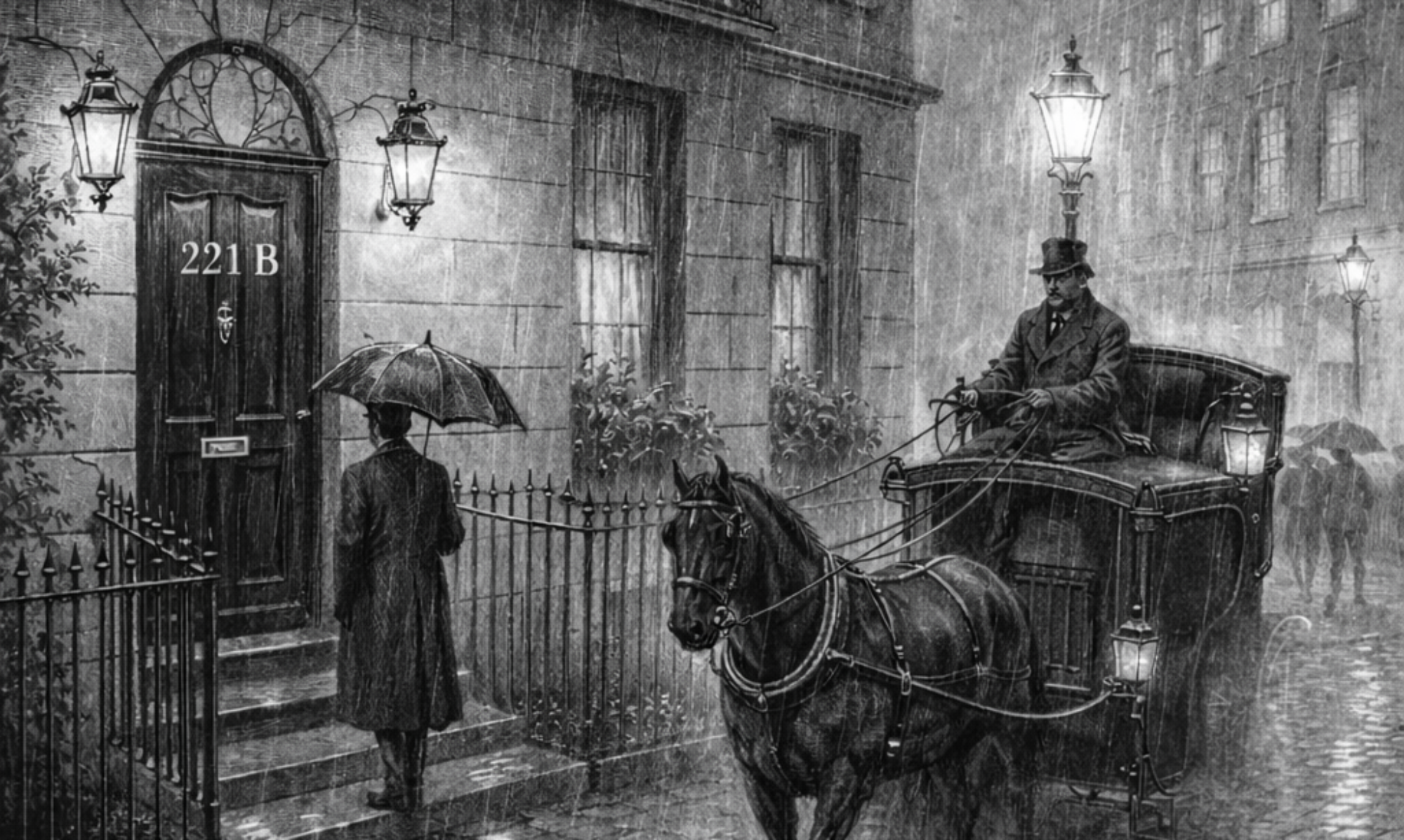
“I have the advantage of knowing your habits, my dear Watson,” said he. “When your round is a short one you walk, and when it is a long one you use a hansom. As I perceive that your boots, although used, are by no means dirty, I cannot doubt that you are at present busy enough to justify the hansom.”
Watson responds:
“Excellent!” I cried.
Holmes simply replies:
“Elementary,” said he.
This is remarkably close to the expression that later became famous, but the two parts—“my dear Watson” and “Elementary”—remain separate.
There are only seven other instances of the word elementary in the canonical Sherlock Holmes stories. By contrast, Holmes uses “my dear Watson” many times. The expression appears in approximately two-thirds of the stories, sometimes more than once in the same story.
Interestingly, Holmes does use another phrase that sounds remarkably similar to the famous quotation: “Exactly, my dear Watson.” According to Sherlockian sources, Holmes says this in three different stories.
One example occurs in His Last Bow, where Holmes uses the expression while responding to Watson. In this case, however, exactly—rather than elementary—is the word paired with “my dear Watson.”
So where did “Elementary, my dear Watson” come from?
The phrase appears to have emerged outside the original Holmes canon, gradually becoming associated with the character through later adaptations, performances, parodies, and popular culture. Its precise wording captures something essential about the popular image of Holmes: the brilliant detective who effortlessly observes a tiny detail, explains the deduction, and dismisses the result as obvious.
The irony is that the quotation itself is therefore almost a Holmesian clue. Everyone remembers something that Holmes never actually said.
The distinction between what Holmes really says and what later generations remember him saying is a perfect example of the detective’s own method: appearances are not evidence. The apparent fact must itself be investigated.
“Elementary, my dear Watson” is not a quotation from Sherlock Holmes. It is a quotation about the idea of Sherlock Holmes.